
How to export from Angola
A step-by-step guide to turning production capacity into international sales
Exporting does not start at the port.
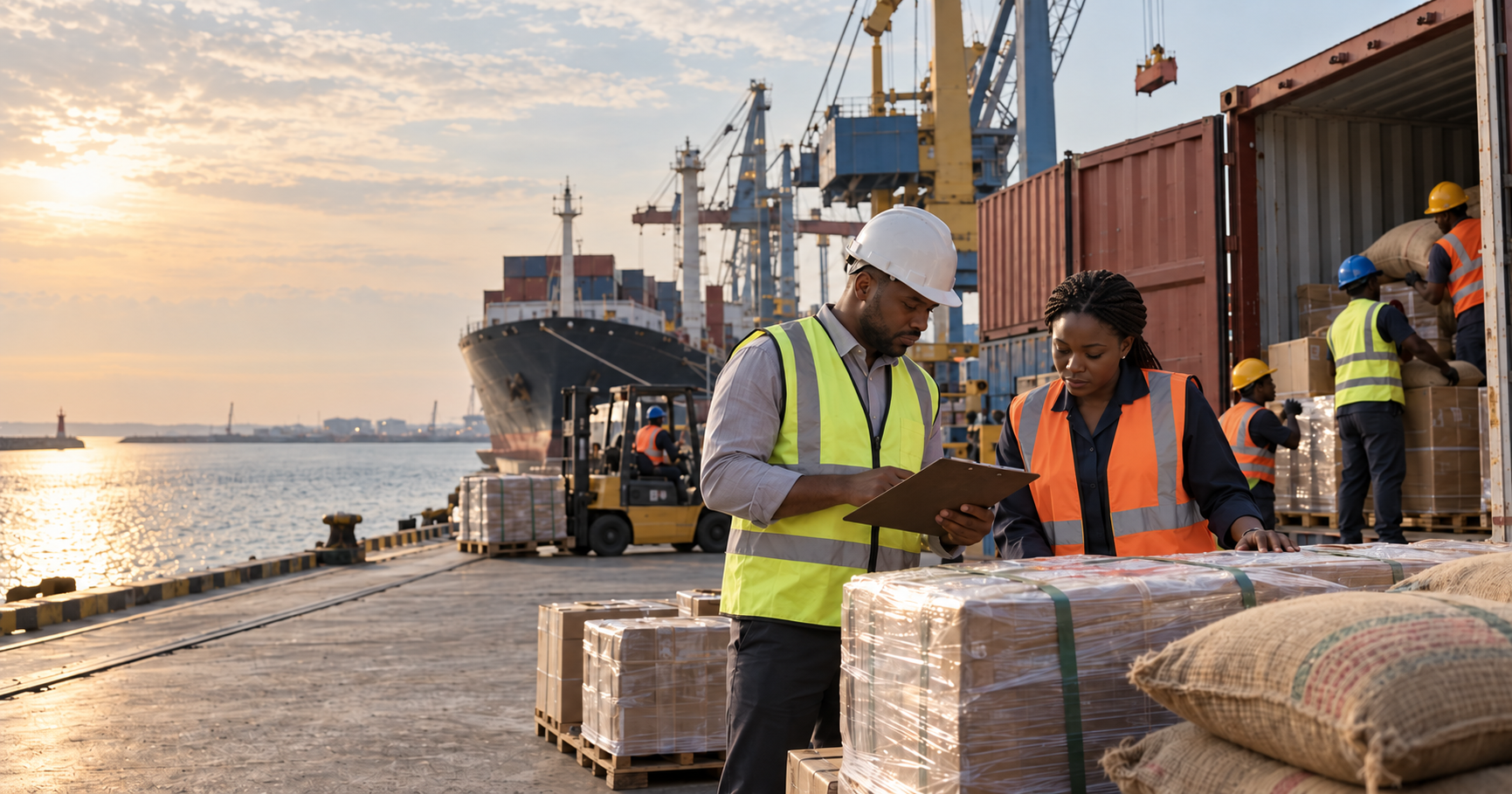
It starts much earlier: when a company can show that it has a product the market wants to buy, the capacity to deliver what it promises, consistent quality, a margin after all costs, coherent documentation and a buyer that can legally import.
This is precisely where many first export attempts fail.
Some companies with good products start with logistics before they know the market. Others pursue certifications before they know what the buyer actually requires. Some win an order, only to discover afterwards that the price does not cover transport, financing, documentation or the costs of entering the destination country.
Exporting requires reversing this logic.
First we define the product and the market. Then we confirm requirements, capacity, price, financing and commercial terms. Only then do we organise documentation, transport, customs clearance and delivery.
The goal is not simply to get goods out of Angola.
It is to build a commercial operation that is legal, profitable, financeable and repeatable.
https://angolaglobalhub.ao/en/how-to-export-from-angola
In this guide
Guide contents
Before you start: what has changed in Angola
Angola's foreign trade has undergone significant changes, and some information still circulating in the market is already out of date.
Certificate of Conformity for Export
The Ministry of Industry and Trade has removed the requirement to apply for the Certificate of Conformity for Export (Certificado de Conformidade para Exportação) and the Goods Export Authorisation Declaration (Declaração de Autorização de Exportação de Mercadorias).
This is an important simplification, but it does not mean an export is no longer subject to the remaining obligations.
Depending on the goods, customs, sanitary, phytosanitary, safety, inspection and other sector-specific rules continue to apply, as do the requirements set by the importing country.
REI — Register of Exporters and Importers
Presidential Decree No. 126/20 establishes, as a general rule and without prejudice to the exceptions provided for by law, registration in the Register of Exporters and Importers (Registo de Exportadores e Importadores — REI).
The decree also sets out procedures for licensing import and export operations and for operators' access to the Foreign Trade IT Platform.
This means the company should confirm its position before starting an operation, and should not assume that removing two documents removed the entire administrative export regime.
Angola, SADC, AfCFTA and AGOA
An Angolan export may benefit from different trade-integration instruments, but no benefit should be assumed.
SADC
Angola has made significant progress in joining the SADC Free Trade Area.
In 2025, Angola's Tariff Offer under the SADC Protocol on Trade was finalised and approved.
The Angolan offer covers a large share of tariff lines, with phased liberalisation planned for some products.
For a company, the practical conclusion is simple:
do not automatically assume that goods exported from Angola benefit from a preferential tariff just because the destination is a SADC member.
For that specific operation, you need to confirm:
- the product;
- the tariff code;
- the destination country;
- the rule of origin;
- the liberalisation schedule;
- the tariff treatment actually applicable;
- the proof of origin required.
AfCFTA
The African Continental Free Trade Area also opens opportunities for Angolan companies, especially as tariff offers, rules of origin and operational mechanisms are implemented.
But here, too, the phrase "African free trade" does not mean customs duties automatically disappear.
Each export must be analysed for the specific product and market.
AGOA and the United States market
The African Growth and Opportunity Act — AGOA was reauthorised in 2026 through 31 December 2026, retroactive to 30 September 2025.
Angola is currently eligible for AGOA.
But this does not mean any Angolan goods can enter the United States duty-free.
You need to confirm:
- whether the product is covered;
- whether it meets the rules of origin;
- its customs classification in the United States;
- the documentation required;
- any sector-specific tariffs or additional trade measures;
- whether the US importer can correctly claim preferential treatment.
To export to the United States, the calculation must be made using the product's specific HS code at the time of sale, not just the generic reference to AGOA.
↑ Back to contentsGoods or services?
Before going further, it is important to distinguish two situations.
Exporting goods
Physical goods leave Angola.
The operation may involve:
- tariff classification;
- licensing;
- technical requirements;
- rules of origin;
- customs clearance;
- transport;
- insurance;
- commercial documentation;
- banking documentation;
- import requirements in the destination country.
Exporting services
An Angolan company can also export:
- consulting;
- engineering;
- software;
- training;
- design;
- technical services;
- digital services;
- specialised projects.
Here, no goods necessarily cross a border.
But contractual, tax, banking and foreign-exchange questions still need to be assessed, including withholding taxes in the client's country, receipt of payment in foreign currency, intellectual property and any tax obligations in the market where the service is provided.
This guide focuses mainly on exporting goods.
↑ Back to contentsBefore the first expense, answer four questions
Before producing special packaging, hiring transport or applying for certificates, the company should be able to answer in writing:
1. What will you export?
Product, technical characteristics, presentation, quantity, monthly capacity and likely tariff code.
2. To whom?
Country, sector, segment and, ideally, an identified buyer.
3. On what terms?
Price, currency, Incoterm, delivery point, quantity, payment and timing.
4. Can the operation be repeated at a profit?
Production, raw materials, quality, logistics, financing and working capital must allow for the second, third and tenth orders.
If these four answers do not exist yet, the company probably does not have an export yet.
It has an intention to export.
Have answers to the four questions? Assess your company’s readiness. Assess export readiness →
↑ Back to contentsThe export route in 12 steps
1. Define the product precisely
Saying you want to export "coffee", "honey", "gindungo" (chilli), "marble" or "bananas" is not enough.
An international buyer needs to know exactly what they are buying.
Depending on the product, the company should define:
- variety;
- composition;
- dimensions;
- moisture content;
- grade;
- weight;
- tolerances;
- packaging;
- shelf life;
- storage conditions;
- supply capacity;
- minimum quantity;
- production lead time.
It should also decide the commercial model:
- own brand;
- private label;
- raw material;
- finished product;
- bulk;
- exclusive distribution;
- industrial supply.
Expected result
A clear technical data sheet and a proposal a buyer can compare with other international offers.
2. Know whether the company can deliver
Being able to produce 10 tonnes once does not mean being able to export 10 tonnes every month.
Before accepting an order, assess:
- installed capacity;
- capacity actually available;
- suppliers;
- availability of raw materials;
- losses;
- rejections;
- quality;
- maintenance;
- equipment;
- traceability;
- human resources;
- storage;
- working capital.
There is also a decisive question:
how much money does the company need to finance between buying raw materials and receiving payment from the foreign customer?
A large order can create a large cash requirement.
An export can be commercially profitable and still cause a financial crisis if the cash cycle is not planned.
3. Confirm the tariff code
The tariff code is not just an administrative number.
It affects:
- customs duties;
- licences;
- controls;
- statistics;
- rules of origin;
- entry requirements;
- trade-defence measures.
The Angolan Customs Tariff currently in force is based on the 2022 version of the Harmonized System Nomenclature.
To classify goods correctly, factors such as the following must be analysed:
- material;
- composition;
- function;
- processing;
- presentation;
- use.
Where there is doubt, the classification should be validated with specialist professionals or with the competent authority.
Copying the HS code used by another company can lead to incorrect classification.
4. Choose the market using data
Do not choose a country just because it is large.
"I want to export to China" or "I want to enter Europe" is not yet a strategy.
Analyse:
- how much of the product the country imports;
- who the main suppliers are;
- average price;
- demand growth;
- competition;
- tariffs;
- technical requirements;
- transport;
- transit time;
- currency;
- distribution channels;
- payment risk.
Then identify specific buyers.
The goal should not be to find just "an interested country".
It should be to find:
the right product + the right buyer + the right price + the right terms.
Angola Global Hub can act precisely at this stage: identifying markets, buyers, partners and commercial opportunities.
5. Confirm whether the product can enter
Once the market is chosen, the regulatory analysis begins.
Ask:
- can the product be imported?
- does it need a licence?
- are there quotas?
- does the producer need to be registered?
- does the importer need to be registered?
- are there sanitary or phytosanitary requirements?
- are laboratory tests needed?
- are there packaging rules?
- what are the labelling rules?
- is there a mandatory technical standard?
- can it benefit from a tariff preference?
- what is the rule of origin?
A common mistake is to think:
"It is produced in Angola, so it originates in Angola."
For customs-preference purposes, that may not be enough.
The rule of origin may depend on the origin of the raw materials, the processing carried out, the value added or a change in tariff classification.
6. Prepare the product and the company's systems
Now we can compare:
what the buyer requires with what the company can currently demonstrate.
It may be necessary to work on:
- procedures;
- hygiene;
- quality control;
- traceability;
- supplier management;
- calibration;
- maintenance;
- documentation;
- packaging;
- storage;
- risk analysis;
- training;
- laboratory testing;
- management systems.
This is also the stage at which you determine whether any certification is actually needed.
An ISO certification is not a universal export licence.
It may be required:
- by the buyer;
- by the sector;
- by a tender;
- by the supply chain;
- by a multinational;
- for commercial or reputational reasons.
Export Lab can support the company with technical preparation, implementing the systems required, internal audits, documentation and training.
Technical preparation by Export Lab; the audit and certification decision are carried out independently by DQS, under our exclusive partnership in Angola.
This separation means that preparation does not guarantee certification and that the final decision remains independent.
7. Calculate the true export price
An international price is not:
price in Angola ÷ exchange rate.
The price must include everything the company will have to bear.
Simplified structure
Product cost
- export packaging
- technical adaptation
- quality control
- testing
- documentation
- inland transport
- customs broker
- terminal
- port charges
- freight, where applicable
- insurance, where applicable
- bank charges
- financing
- commissions
- contingency
- margin
export price
You then need to define exactly how far this price takes the goods.
That is what Incoterms® 2020 are for.
8. Choose the right Incoterm
It is not enough to write:
FOB.
The term must also identify the exact point and the version used.
For example:
FCA [exact place], Luanda — Incoterms® 2020.
or
CIF [named port] — Incoterms® 2020.
Incoterms determine matters such as:
- who arranges transport;
- who bears certain costs;
- who assumes certain risks;
- at what point risk passes from seller to buyer.
But there is an essential distinction:
an Incoterm is not a payment method.
You can sell FCA and be paid in advance.
You can sell CIF through a documentary credit.
They are different decisions.
9. Check the buyer before producing
Finding a buyer does not mean finding a good buyer.
Before committing production or granting credit, check:
- legal existence;
- address;
- activity;
- people in charge;
- trade references;
- import capacity;
- track record;
- relevant litigation;
- any sanctions;
- commercial reputation.
For a first operation, caution is especially important.
There must then be a commercial document that clearly sets out:
- product;
- specification;
- quantity;
- tolerances;
- price;
- currency;
- Incoterm;
- delivery point;
- payment;
- dates;
- packaging;
- inspection;
- claims;
- force majeure;
- dispute resolution.
A WhatsApp conversation can start a deal.
It should not replace the contract.
10. Prepare the operation in Angola
Before shipment, confirm the administrative position.
The company should check:
- tax identification number (NIF);
- commercial documentation;
- legally authorised activity;
- REI status;
- any licence for the goods;
- sector-specific authorisations;
- Customs Tariff requirements;
- the customs broker's involvement;
- the intermediary bank.
Ideally, involve the bank before the goods are ready.
11. Organise the banking and foreign-exchange side
Foreign-exchange operations linked to goods exports must be set up with the intervening banking institution.
Depending on the operation, arrangements may include:
- advance payment;
- exporter credit;
- documentary credit.
Under Notice No. 4/21, the Payment Commitment Declaration (Declaração de Compromisso de Pagamento) is required to allow customs clearance of exported goods, within the applicable foreign-exchange framework.
Receipt of export proceeds must also be structured through the applicable banking system in Angola.
So:
do not treat the bank as the last stage of the export.
Treat it as part of the structure of the operation.
12. Assemble the document file, clear customs and follow through
Documents vary by product and destination, but an operation may involve:
- pro forma invoice;
- contract or purchase order;
- commercial invoice;
- packing list;
- licences;
- sector-specific certificates;
- certificate or declaration of origin;
- banking documentation;
- Payment Commitment Declaration;
- Single Document (Documento Único);
- transport document;
- insurance.
One operating principle is especially important:
all documents must tell the same story.
The buyer's name, product description, quantity, weight, currency, price, Incoterm and destination must not vary unexplained between documents.
Small documentary inconsistencies can cause delays, banking problems, customs difficulties and commercial disputes.
↑ Back to contentsWhen the container leaves, the export is not over
A company should not consider the operation complete when the goods leave Angola.
You need to follow:
- clearance;
- transport document;
- transit;
- transhipments;
- arrival;
- import;
- delivery;
- acceptance;
- claims;
- payment.
If there is insurance and damage, loss or an incident occurs, the notification procedures and deadlines must be respected.
Keep:
- photographs;
- documents;
- correspondence;
- proof of delivery;
- bank receipts;
- inspection reports.
Real exporting starts with the second order
A first sale can come from opportunity.
An exporting company builds repetition.
After each operation, compare:
- forecast price;
- actual cost;
- forecast margin;
- actual margin;
- forecast lead time;
- actual lead time;
- losses;
- claims;
- unexpected costs;
- logistics performance;
- payment.
Ask the customer:
Would you buy again?
Then fix the problems before the next order.
The goal is to turn:
a sale into a customer and then turn that customer into a predictable commercial relationship.
↑ Back to contentsDocuments: there is no universal list
One of the most frequent questions is:
"What documents do I need to export?"
The correct answer is:
it depends.
It depends on the product, destination, tariff classification, payment method, transport and applicable regime.
Even so, this matrix helps guide the process:
| Area | Document or evidence |
|---|---|
| Company | NIF, commercial registry certificate, authorisation for the activity |
| Foreign trade | REI, where applicable |
| Commercial | Proposal/pro forma invoice |
| Commercial | Contract or purchase order |
| Commercial | Commercial invoice |
| Logistics | Packing list |
| Customs | Export licence, where required |
| Customs | Single Document (Documento Único) |
| Banking | Payment Commitment Declaration, according to the regime |
| Origin | Certificate or declaration of origin, where required |
| Sector-specific | Sanitary, phytosanitary, veterinary or technical certificates |
| Transport | Bill of Lading, Air Waybill or road transport document |
| Risk | Insurance policy or certificate |
| Destination | Import licences and registrations required by the buyer's country |
Example: Angolan coffee sold to a distributor in Portugal
Imagine a company that wants to export roasted coffee from Angola to Portugal.
The process does not start by asking:
"How much does it cost to send a container?"
It starts like this:
1. Define the coffee
Variety, origin, roast, packaging, weight, shelf life, profile and monthly capacity.
2. Confirm classification
Determine the exact tariff code for the coffee in the form in which it will be exported.
3. Identify the buyer
Distributor, retailer, HoReCa (hotels, restaurants and cafés), specialist shop or private label.
4. Validate European requirements
The importer should confirm entry requirements, food safety, traceability, labelling and the economic operator's responsibilities.
5. Approve samples
The buyer approves the product, packaging and specifications before commercial production.
6. Calculate the price
Product
- packaging
- quality
- documentation
- inland transport
- terminal
- clearance
- freight, if applicable
- insurance, if applicable
- financing
- margin.
7. Choose the Incoterm
With the delivery place precisely identified.
8. Agree payment
Advance payment, documentary credit or another structure suited to the risk and framework of the operation.
9. Prepare documentation
All documents must carry consistent information.
10. Follow delivery
Only after payment, acceptance and calculation of the actual margin do we know whether the operation worked.
↑ Back to contentsThe mistakes that most often destroy a first export
- Poorly defined product.
- Buyer not verified.
- Wrong tariff code.
- Market chosen only because it is large.
- Production accepted without the financial capacity.
- Certification obtained without knowing whether the market requires it.
- Label created without regulatory validation.
- Rule of origin assumed.
- Domestic price converted straight into dollars.
- Incomplete logistics costs.
- Incoterm misused.
- Credit granted to an unknown customer.
- Bank involved too late.
- Documents with different data.
- First sale celebrated without calculating the final margin.
Checklist before shipping
Your selections are saved on this device only.
↑ Back to contentsWho should do what?
Exporter
Product, capacity, documentation supplied, commercial terms and compliance with its obligations.
Buyer/importer
Import at destination, the licences it is responsible for, payment and receipt of the goods.
Bank
Foreign-exchange processing and payment method within the applicable framework.
Customs broker
Customs procedures within the scope of the mandate received.
Freight forwarder and carrier
Physical movement of the goods and transport documentation.
Insurer
Cover for the risks contracted.
Authorities
Licensing, inspection and certifications within their competence.
Angola Global Hub
Identifying and structuring market opportunities, buyers, partners, negotiation and commercial development.
Export Lab
Technical preparation of the company: processes, management systems, compliance, documentation, training, quality, risk and readiness to meet market requirements.
↑ Back to contentsOur model: opportunity → preparation → market
At Angola Global Hub we start from a simple idea:
it is not enough to find buyers for companies that are not yet ready to export.
Nor is it enough to prepare companies technically if they have no access to the market.
The two dimensions have to work together.
1. We identify the opportunity
Market, buyer, partner or demand.
2. We assess the company
Product, capacity, processes, documentation, quality, financing and requirements.
3. We close the gaps
Where there are technical gaps, Export Lab works with the company on the preparation needed.
4. We structure the operation
Price, financing, logistics, documentation, counterparty and commercial terms.
5. We connect the company to the market
The end goal is the sale.
6. We work to create repetition
Because a one-off export is a transaction.
A recurring portfolio of international customers is an internationalisation strategy.
↑ Back to contentsOne last rule
Before spending money on an export, answer this question:
Is someone willing to buy this product, on these terms, at this price?
Then answer another:
Can my company deliver exactly what it promised and make money doing it?
When both answers are yes, we have a basis to work with.
Everything else — certification, financing, logistics, documents, clearance and transport — should be organised to make that sale possible and repeatable.
Because exporting is not putting a container on a ship.
Exporting is building an international commercial relationship that works.
↑ Back to contentsDecision tree for regulated products
Use this sequence before asking for a logistics quote:
-
Are these physical goods? If not, follow the services-export route. If so, determine the tariff code.
-
Does the Angolan Customs Tariff indicate a prohibition, restriction or control? If so, identify the competent authority and obtain authorisation before shipment.
-
Does the product belong to a regulated category? Check specifically food, plants, seeds, animals, fish, timber, wildlife, minerals, diamonds, petroleum, chemicals, medicines, medical devices, telecommunications, dual-use goods and cultural goods.
-
Does the destination country require registration, a licence, testing, a certificate or an authorised operator? Confirmation must come from the destination authority and the importer, not just the freight forwarder.
-
Do you intend to claim a tariff preference? Confirm product eligibility, the rule of origin, the proof required and the importer's ability to claim the benefit.
-
Does the buyer require an additional certification? Determine whether it is a contractual, sector or channel-access requirement. Do not confuse a private requirement with a universal legal obligation.
-
Is the answer still uncertain? Do not ship. Obtain written confirmation from the authority, the customs broker, the bank or the responsible importer.
Essential glossary
- Tariff/HS code
- code used to classify goods in international trade.
- DU
- Single Document (Documento Único) used for the customs declaration and clearance.
- REI
- Register of Exporters and Importers (Registo de Exportadores e Importadores).
- Incoterms® 2020
- ICC rules that allocate delivery tasks, costs and risks between seller and buyer.
- FCA
- delivery to the carrier at the named place, after the seller's export formalities.
- FOB
- delivery of the goods on board the vessel at the port of shipment; a sea and inland waterway rule only.
- CIF
- sea rule under which the seller contracts freight and insurance to the named port, although risk passes on shipment.
- DAP
- delivery at the named place of destination, ready for unloading, with import normally handled by the buyer.
- Rule of origin
- criterion that determines whether the product can be considered originating for a trade regime.
- Certificate of origin
- proof of origin issued or declared under the applicable regime.
- Documentary credit
- a bank's undertaking to pay against documents that comply with the stated terms.
- Packing list
- list of packages with volumes, weights, markings and contents.
- Traceability
- ability to follow raw materials, process, batch and destination of the product.
- Landed cost
- total cost of the goods placed at the defined destination, including the elements the operation allocates to each party.
Frequently asked questions
1. Can any Angolan company export?
The company must be legally incorporated and authorised for the activity, meet the applicable registration requirements and confirm the regime for the goods. Presidential Decree No. 126/20 provides for the REI as a general rule, with specific exceptions.
2. Do I always need an export licence?
This should not be answered universally. The regime may be exemption, automatic licensing or non-automatic licensing. It depends on the goods and on special rules. Confirm on the platform and with the competent authority before shipment.
3. Is the Certificate of Conformity for Export still mandatory?
MINDCOM (Ministry of Industry and Trade) announced the removal of the requirement for that certificate and for the Goods Export Authorisation Declaration. This does not remove sanitary, phytosanitary, technical or origin certificates, or buyer and destination requirements, where applicable.
4. Do I need an ISO certification to export?
Not in every case. The obligation may arise from law, the sector, the buyer, a tender or the distribution channel. A management-system certification does not replace licences and does not automatically certify the product.
5. What is the best payment method?
It depends on the risk, negotiating power, country, value and track record. Advance payment reduces the exporter's risk; a documentary credit can add security if correctly structured; credit to the buyer requires assessment and financial capacity. Involve the bank before closing the contract.
6. Can I use AGOA, AfCFTA or SADC to pay lower duties?
Perhaps, but never automatically. Confirm the product, the country, current eligibility, the rule of origin, the proof required and the importer's ability to claim the preference. AGOA is currently in force only until 31 December 2026; SADC implementation must be confirmed for the specific shipment.
7. How long does it take and how much does it cost to export?
There is no universal timeframe or cost. They depend on the company's readiness, the product, authorisations, testing, the buyer, production, transport and payment. A serious quote requires this information. Any promise of a timeframe or price without knowing it is only an estimate.
8. Should I look for the buyer first or prepare the company first?
Run both processes in a coordinated way. The market helps define requirements, but you should not promise what you cannot yet deliver. A conversation with buyers can avoid wasted investment; a readiness diagnostic avoids losing the buyer when the opportunity appears.
Official and normative sources consulted
Angola
- Ministry of Industry and Trade — removal of the requirement for the Certificate of Conformity for Export and the Export Authorisation Declaration — Ministry of Industry and Commerce
- Presidential Decree No. 126/20 of 5 May — administrative licensing procedures, REI and the foreign trade platform — Lex.ao (legal database, not issuing authority)
- BNA Notice No. 4/21 of 14 April — foreign-exchange operations for the import and export of goods — Lex.ao (legal database, not issuing authority)
- Presidential Legislative Decree No. 1/24 of 3 January — Customs Tariff based on the Harmonized System 2022 — Lex.ao (legal database, not issuing authority)
- Executive Decree No. 67/17 of 14 February — Single Document (Documento Único) — Lex.ao (document) (legal database, not issuing authority)
- General Tax Administration (AGT) portal — General Tax Administration (AGT)
- Fishery products — Presidential Decree No. 57/17 — Lex.ao (legal database, not issuing authority)
- Forest and wildlife products — Executive Decree No. 385/16 — Lex.ao (legal database, not issuing authority)
- Cultural goods — Presidential Decree No. 87/20 — Lex.ao (legal database, not issuing authority)
International markets and instruments
- World Customs Organization — Harmonized System 2022 — World Customs Organization
- International Chamber of Commerce — Incoterms® 2020 — International Chamber of Commerce (ICC)
- European Commission — Access2Markets — European Commission — Access2Markets
- African Union — Agreement establishing the African Continental Free Trade Area — African Union
- SADC — Angola's accession and certificates of origin — SADC
- U.S. Customs and Border Protection — AGOA reauthorisation through 31 December 2026 — Official notice (GovDelivery)
- International Plant Protection Convention — phytosanitary certificates — International Plant Protection Convention (IPPC)
Sources accessed on: 28 September 2026.
↑ Back to contents